Real Oviedo will be relegated—there is no room for self-deception at this stage—but they will not go down without a fight. Official confirmation could come as soon as tomorrow if Girona picks up a single point, and it will be the direct result of a catalog of errors too long to survive in La Liga. A deserved relegation, yes. But at least this team has saved one final gesture of dignity: not mathematically dropping through the trapdoor on their own Tartiere turf.
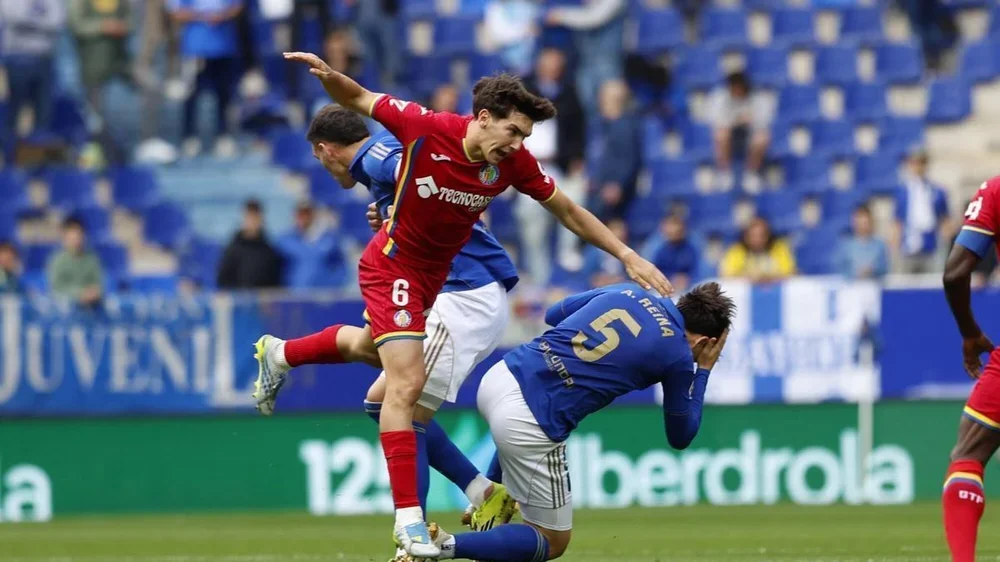
It could have happened against Getafe on another bewildering afternoon of this strange invention called “VAR football,” with Soto Grado overwhelmed and indifferent. Oviedo survived with two fewer players for an extended stretch, clinging to the match with their fingernails, perhaps offering the most competitive and proud image of the entire season. Late and insufficient, but in a campaign with so few memorable moments, at least one game stands up for pride: not enough in football terms, but the squad is overflowing with attitude.
They didn’t win, which was the only thing keeping the survival flame alive, but they avoided defeat, which would have meant confirming relegation in front of their own fans with the curtain falling abruptly in the middle of the Tartiere. And in such a harsh year, so short of joy, that is almost a small moral victory—a brief gasp of pride before an ending that has been written for too long.
The highlights came in a second half of guerrilla warfare, football with little tactical control, which allowed Oviedo to impose a carefree style, knowing everything was already lost. But before that, the match was the opposite: two controlled approaches and a game of who makes fewer mistakes.
That is typical and well-practiced for Getafe. Much more surprising for Oviedo, who by playing cautiously fell into the trap set by Bordalás’s side. The first half featured plenty of direct play and collisions, with little football and even fewer interesting actions. A challenge for anyone having to pick highlights. Oviedo, who always looked slightly more uncomfortable, can at least say they had the clearest chance. It came from the only combination play of the first half: a slalom by Hassan reminiscent of better times, a low cross, and Chaira, playing as an improvised attacking midfielder, arriving on time to shoot. His volley hit the post.
From Geta, no flood of chances was expected, but plenty of order and a well-structured shape. The good thing about Bordalás is that you always know the menu of the day. The closest approaches came from set pieces and long-range shots. Davinchi and Mario Martín tried their luck, and both opportunities ended the same way: with a sharp save from Aarón. The three minutes of added time in the first half smelled of doom.
Controversy Arrives
The hardest test for Oviedo came shortly after the break. That familiar twist of fate appeared—so often with a whistle and a hand to the ear. On this occasion, it was to suggest to Soto Grado that Javi López’s tackle deserved a red card. No one knows why, as we are used to this VAR era where interpretations swing from one week to the next, confusing fans.
Two headers from Getafe almost deepened the wound but missed the target. Oviedo defended not just with dignity but also with organization and good ideas on the ball. Chaira tested Soria, and then Sancris tested Aarón with a dangerous free kick. The goalkeeper had already been the best player on the pitch for some time.
But there was more refereeing farce to come. Sibo came in hard on a loose ball, perhaps excessively, and Soto Grado—completely out of the game—let play continue. He was then called to the monitor and shown a straight red card to Sibo.
At that point, heroics were needed. Defending an insufficient point at least demonstrated that the fall would not be due to a lack of attitude or fight. They even had a chance in a counterattack orchestrated by Cazorla, but Soria blocked before C.