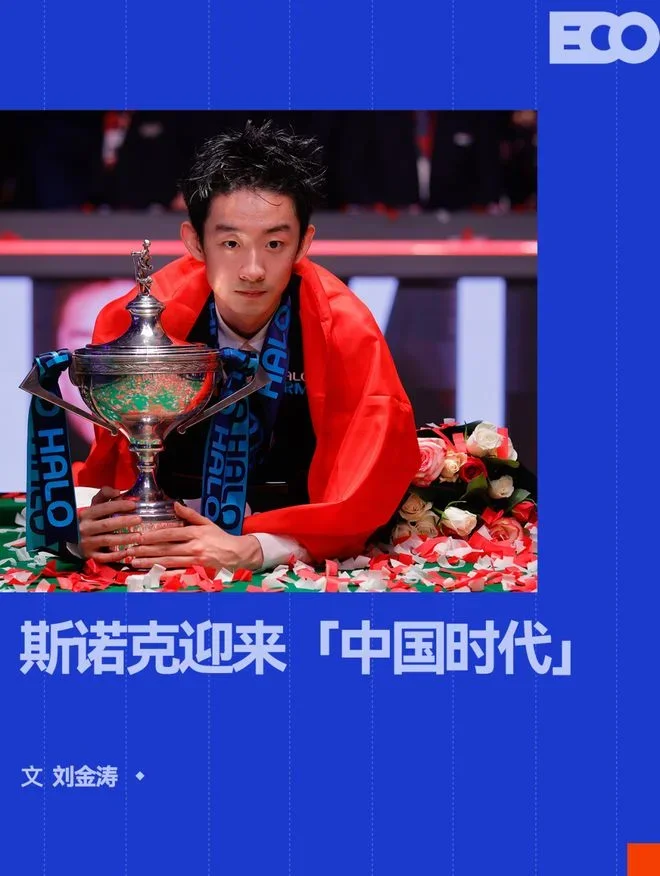
When the match ended, the Crucible Theatre erupted in long-suppressed cheers.
Wu Yize did not celebrate immediately. He stood by the table, as if confirming the reality, then embraced his opponent amid the applause. The stage that has witnessed snooker’s century-long history welcomed its fourth consecutive new champion.
This time, it was a 22-year-old Chinese player.
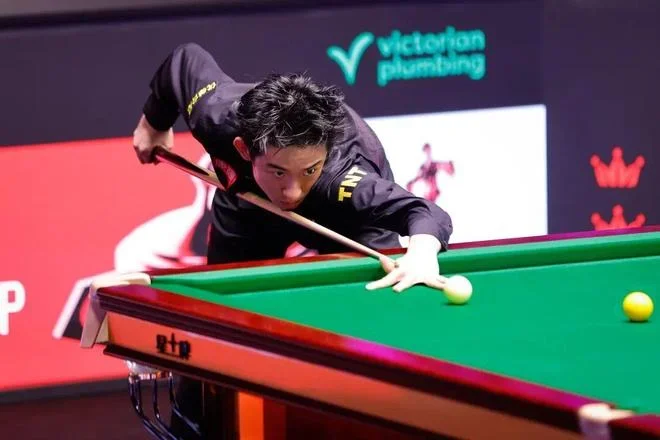
The scoreboard read 18-17. It marked the first World Championship final to go to a deciding frame in 24 years. Opponent Shaun Murphy, an experienced player who had eliminated three Chinese players in succession, watched as Wu Yize, trailing in the final frame, gambled on a risky long pot. The red ball dropped, and consecutive scoring sealed the match.
He put down his cue, exhaled softly, and smiled like a victor.
This was more than just a champion’s birth.
For two consecutive years, the World Snooker Championship title has belonged to Chinese players—from Zhao Xintong to Wu Yize. The narrative of this sport is shifting.

Unlike before, Wu Yize’s victory this time was rarely discussed as an “upset” or “miracle.”
Throughout the tournament, Wu Yize showcased his talent, hard work, and mental strength.
In the second round, he faced four-time world champion Mark Selby, whom he had never beaten in six previous encounters. Against his “nemesis,” he entered a fierce battle in the third session but still found the perfect opportunity to win.
In the semifinal, Wu Yize faced Northern Ireland star Mark Allen. He leveled the score and dragged the match into a deciding frame, then in the 33rd frame, he made a break of 71 to save three match points and complete a 17-16 comeback.
In the final, Wu Yize faced Shaun Murphy, who had already defeated three Chinese players. The match went back and forth, and for the first time in 24 years, the World Championship final entered a deciding frame. In that frame, Wu Yize held his nerve and finished the match.
After making history at the Crucible, Wu Yize admitted that the belief in winning supported him: “I have always dreamed of being a world champion. I think no one in this tournament wanted it more than me. I was willing to give everything for it.”
“What does Wu Yize’s early fame mean? Besides talent, it’s more about hard work. He can endure hardship, withstand high-intensity closed training, and bear long-term loneliness in an overseas training environment. This championship was not easy,” said Ms. Jie, co-founder of Snooker Boya Agency, told the sports industry media.
This season has seen a collective explosion of Chinese snooker.
Among the 32 spots in the main draw of this World Championship, 11 were Chinese players. Additionally, Xiao Guodong, Wu Yize, and Zhao Xintong together won seven titles, setting a record for the best single-season performance by the Chinese contingent.
Looking back over the past two decades, the sport’s development path in China has been tough. From Ding Junhui’s solo brilliance to today’s multiple breakthroughs, Chinese snooker players have completed a collective rise.
After the match, Ding Junhui immediately congratulated Wu Yize, writing: “From Zhao Xintong to Wu Yize, Chinese players have stood on the highest podium of the World Championship for two consecutive years. This is not just a breakthrough; our era is coming!”
The Chinese Billiards Association wrote in a congratulatory letter: “Your victory will further enhance the competitiveness and influence of Chinese snooker on the international stage, greatly inspire national pride, and encourage more young people to engage in billiards.”
Opponent Shaun Murphy expressed respect in the post-match press conference, saying bluntly: “I don’t think I lost the final; he won it. The red ball he potted into the middle pocket showed immense courage.” Murphy had previously predicted that the young Chinese player would one day become a world champion, humorously adding, “It’s just a pity that day is today.”
Indeed, Chinese players’ advantages in age structure, quantity scale, and growth density are redefining the competitive landscape of the sport.
Wu Yize’s path to success is both a success story and a sample worth examining.
He started from Lanzhou, moved south to Dongguan for systematic training, backed by his family’s long-term financial and time investment. This model of family support runs through the growth process of a generation of Chinese billiard players.
Whether it was Ding Junhui’s family relocation or Zhao Xintong and Wu Yize’s journey through domestic training, studying in the UK, and competing professionally, it is essentially a high-risk, high-investment path. Families bear the initial costs, pushing individuals onto the professional track, betting on uncertain returns.
It’s no wonder that after the match, Wu Yize received the trophy with his parents and said: “They are the real champions… My father has always been with me, and my mother has gone through many things over the years. They are my eternal spiritual strength.”
From Ding Junhui to Zhao Xintong, the cultivation of Chinese billiard talents has undergone a long period of exploration. However, compared to a decade ago, the key change is that snooker in China has become a predictable career path.
There are multiple official and commercial snooker academies in China, coupled with parental willingness to invest, forming a relatively complete reserve system.
“Players mainly grow in China. Wu Yize is a representative example. Going to the UK is mainly for convenience in competitions. Compared to China, the UK does not have obvious teaching advantages,” Ms. Jie said.
With this victory, Wu Yize earned 500,000 pounds in prize money and will rise to a career-high world ranking of No. 4. He said, “I think I will buy a house or apartment in Sheffield to facilitate daily training and preparation for the World Championship.”
In fact, even if Wu Yize hadn’t won, his strength would have ensured stable and considerable income from tournament earnings and endorsements.
But does this mean the “family support” model is replicable? The cruelest reality in cultivating snooker players is that for every professional player produced, there may be dozens of families who give up midway.
If Chinese snooker wants to turn its collective advantage into long-term dominance, it must lower the entry barrier for talent and gradually incorporate the risks borne by families into standardized youth training systems.
In recent years, the increase in local professional tournaments, the initial establishment of club systems, and the regional concentration of training resources have made talent growth more diverse. But these are far from enough.
High-quality training institutions, experienced coaching teams, and scientific training methods need to be built with greater intensity and speed across the industry.
From a broader perspective, a stronger two-way dependency relationship has formed between snooker and China.
For this sport originating in the UK, traditional markets are stabilizing or even stagnating.
However, Ding Junhui helped open up the incremental market in China and Asia for snooker. The victories of Wu Yize and Zhao Xintong will further leverage a “multiplier effect” to boost the entire Chinese billiard industry.
In March this year, the Chinese Billiards Association held a press conference for its new tournament system, introducing the China Billiard Club Professional League (CBL League), with eight founding clubs unveiled simultaneously. The four main events include the National Amateur Billiards “King of Kings” Tournament, the Snooker/Huacai/Pool National Tour and National Championships, and the China Billiard Club Professional League.
Now, China not only has audiences but also a massive billiard industry chain, sponsors, tournament hosting capabilities, and a steady stream of young players. These elements together form the key variables for the future development of snooker.
Currently, China has tens of millions of billiard enthusiasts, one of the largest participation bases globally.
On this basis, the billiard-related industry chain has gradually taken shape, from club operations and training systems to tournament operations and table and equipment manufacturing, forming a complete supply chain.
In addition, cities like Yushan in Jiangxi, branded as “billiard cities,” host world-class events to build tournament IPs and city brands. Dongguan, relying on training resources and club systems, has become a key gathering place for professional players.