
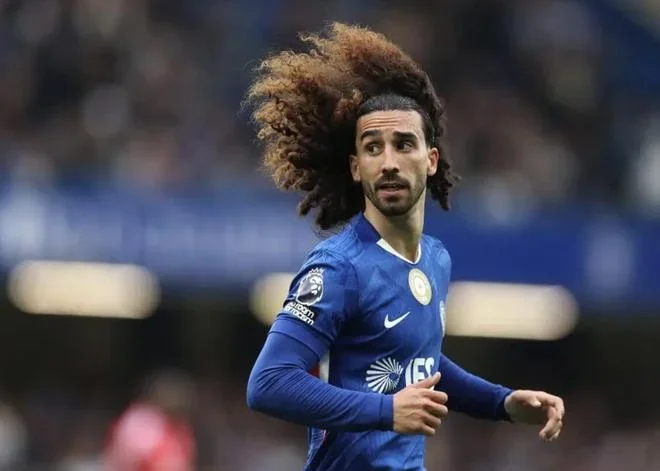
On May 12, The Athletic reported that Chelsea’s severe injury and suspension crisis among their front-line players forced them to rely on Marc Cucurella as their primary attacking threat against Liverpool. The outlet argues that Chelsea’s summer transfer strategy should not focus on simply adding more players to the squad, but on building a stronger, more adaptable, and more resilient lineup.
During Chelsea’s match against Liverpool last Saturday, Cucurella emerged as the closest thing to a left winger for the Blues—a stark reflection of the club’s absurd reality this season. The fact that he won Man of the Match at Anfield should serve as a wake-up call.
If told in August that Cucurella would become Chelsea’s most dangerous attacking weapon in a game crucial for Champions League qualification, fans would have wondered what had happened to their real forwards. Cucurella is known as a dynamic full-back who regularly pushes forward and enters the box, but he was always meant to partner with a proper winger. However, all five senior wingers registered in Chelsea’s first-team squad, plus rising star Derry, were absent for the trip to Merseyside.
If Cucurella has become the answer to Chelsea’s left-wing problem, what exactly is the question? The situation is now so dire that fans might need a mnemonic to remember all the wingers’ misfortunes—though terms like “hamstring tear” and “suspected doping violation” are hard to rhyme.
Mykhailo Mudryk, who joined Chelsea for an initial €70 million in January 2023, has not played since December 2024 after being suspended for violating FA anti-doping rules. He maintains his innocence and is appealing a potential four-year ban. Meanwhile, Gittens and Estevão are sidelined with hamstring issues—Gittens has been out since January, and Estevão last played on April 18 against Manchester United. Garnacho and Pedro Neto missed the last two games due to “muscle-related problems,” as described by caretaker manager MacFarlane. The club hopes they can recover for the FA Cup final against Manchester City on Saturday, but their availability at Wembley remains uncertain.
These injuries led to an unprecedented scenario: against Nottingham Forest last Monday, 18-year-old Derry made his Premier League debut but was forced off after a severe head collision. He was taken to hospital as a precaution, and MacFarlane said preliminary results were “very positive.”
All this culminated in Saturday’s game. With few attackers available, MacFarlane started with a five-man defense, and Cucurella, nominally the left wing-back, tied as Chelsea’s player with the most touches in Liverpool’s box. This raises a serious question: how can a club that spent over £200 million on wingers end up relying on a full-back for attacking output? Head collisions like Derry’s are hard to prevent, and Chelsea cannot be blamed for not trying to replace Mudryk—they signed Garnacho and Gittens last summer. Bad luck is part of the problem, and Chelsea is not alone in discovering that spending money does not guarantee availability. Liverpool, for example, started Cody Gakpo as striker, brought Alexander Isak off the bench after another injury, and lost Hugo Ekitike to an Achilles tendon rupture.
Chelsea has tried to avoid this situation, but the simultaneous injury crisis in one area exposes a need for more “reliability” and “versatility” in the squad. Consider Estevão and Gittens: both are hugely talented signings, with Estevão showing more promise this season. Their technical profiles fit Chelsea’s model, but football is not just about ideals. Neither had played in a league as physically demanding as the Premier League. Data shows that Premier League players cover significantly more sprint distance than those in other European leagues. Compared to Estevão’s former club Palmeiras in Brazil, the total sprint distance in the Premier League was about 16% higher last season. Signing players unaccustomed to such loads—despite Chelsea’s rotation efforts—carries inherent risk. Moving forward, prioritizing players with proven physical durability, in addition to technical ability, would be a wiser strategy.
Cucurella’s performance also highlights the need for Chelsea to find players capable of playing multiple positions. His ability to operate as a traditional full-back, wing-back, or even tuck into midfield is what makes him so valuable. In contrast, against Liverpool, MacFarlane was reluctant to experiment with João Pedro on the wing (perhaps alongside Palmer) while using Delap as a striker—despite saying he didn’t want to pigeonhole João Pedro as a No. 9. The fact that Delap sat on the bench for the entire game, despite the shortage of attackers, is concerning. He had played on the right against Arsenal in February but failed to show he can be effective elsewhere.
Notably, former manager Maresca wanted to sign a new center-back after Colwill suffered an ACL injury early in pre-season—even though the club already had numerous players in that position. The subsequent months proved his concerns valid: no one else possessed Colwill’s traits in build-up play and distribution. “Having options” does not equal “having depth.” On paper, Chelsea has enough wingers and center-backs to handle most injury scenarios. But reality proves otherwise. This summer, the club’s priority should not be building a bigger squad, but creating a stronger, more adaptable, and more resilient team.